

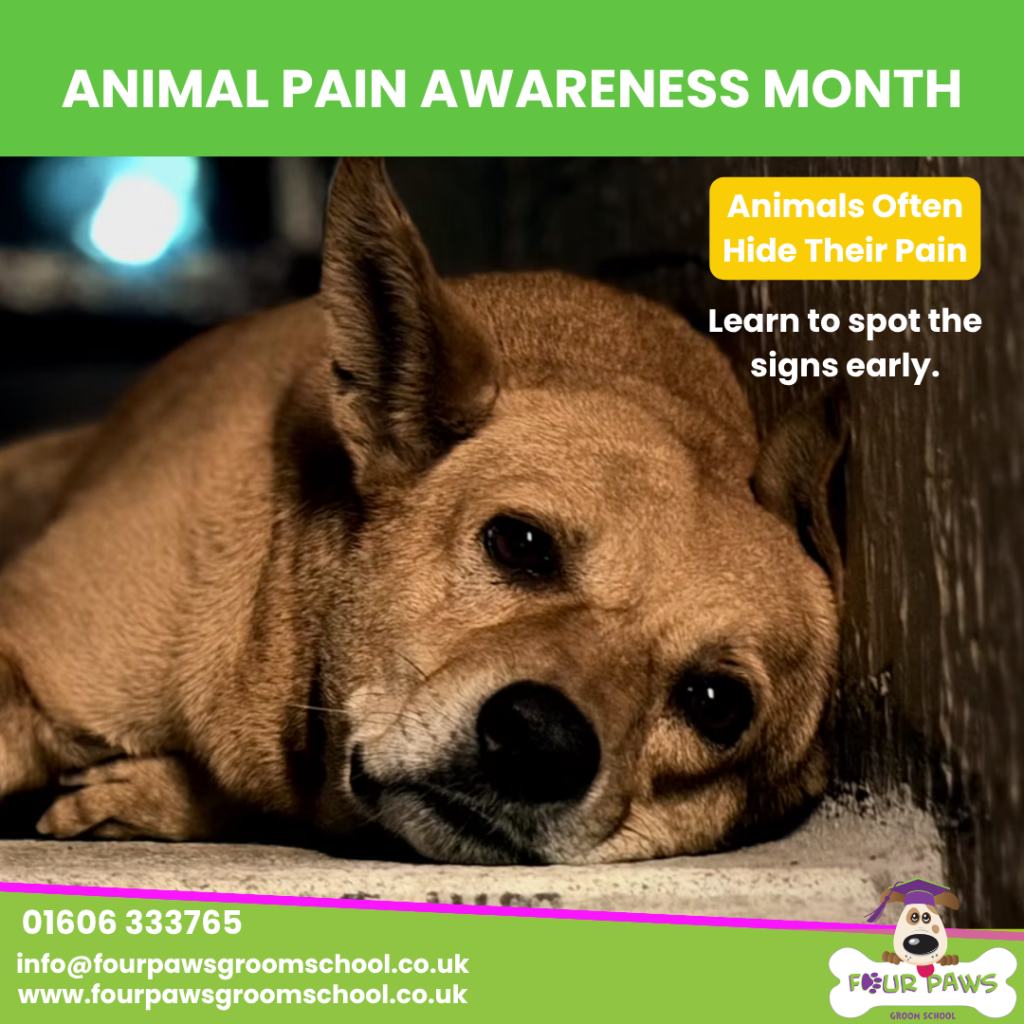
Animal Pain Awareness Month: Learning to Recognise the Signs of Pain in Our Pets
At Four Paws Groom School, we believe that great grooming is about so much more than making a dog look beautiful. It’s about their comfort, well-being and welfare too.
Animal Pain Awareness Month is an important opportunity to remind pet owners and professionals that animals can be incredibly good at hiding pain.
As groomers, we are often in a unique position. We handle dogs regularly, observe their behaviour closely and may notice subtle changes that their owners haven’t seen. Understanding the signs of pain can help us recognise when a dog may need further veterinary attention.
Why do animals hide pain?
In the wild, showing weakness can make an animal vulnerable, so many animals have evolved to hide signs of discomfort.
This means that a dog doesn’t necessarily have to cry, limp or visibly react for them to be experiencing pain.
Sometimes the signs can be much more subtle.
A dog that suddenly becomes reluctant to jump, doesn’t enjoy being handled in a particular area, becomes unusually quiet or starts behaving differently may be trying to tell us that something isn’t right.
Signs of pain groomers should be aware of
During a grooming appointment, keep an eye out for changes in behaviour and body language.
Some possible signs include:
- Becoming unusually withdrawn or quiet
- Restlessness or difficulty settling
- Trembling or shaking
- Excessive panting when the environment isn’t particularly warm
- Growling, snapping or attempting to bite when handled
- Suddenly becoming sensitive around a particular area
- Reluctance to stand for long periods
- Difficulty getting onto or off the grooming table
- Changes in posture
- Limping or stiffness
- Reluctance to move
- Repeatedly licking or chewing a particular area
- Changes in facial expression
- Flattened or pinned-back ears
- A tucked tail or generally tense body
- A dog that is normally happy to be groomed suddenly becoming fearful or resistant
One sign alone doesn’t necessarily mean an animal is in pain. However, a combination of changes, particularly if they are new or unusual for that individual dog, should never be ignored.
Groomers aren’t vets, but we can be an important extra pair of eyes
It is important that groomers don’t attempt to diagnose or treat medical conditions.
Our role is to observe, recognise potential concerns and communicate appropriately with the owner.
For example, if a dog suddenly reacts when a particular area is touched, rather than assuming the dog is simply being difficult, consider whether there could be an underlying reason.
A calm conversation with the owner may reveal something important.
If you have concerns about an animal’s health or well-being, recommend that the owner seeks advice from their veterinary professional.
Handling dogs with possible pain
If you suspect a dog may be uncomfortable, consider adapting your approach.
This could include:
Taking things slowly: Give the dog time to settle and avoid unnecessary handling.
Watching body language: Don’t rely solely on vocalisations. Look at the whole dog and notice changes in posture, facial expression and behaviour.
Avoiding unnecessary pressure: If a particular area appears painful or sensitive, don’t repeatedly manipulate it.
Using appropriate restraint: Grooming should never involve forcing an animal through significant distress or discomfort.
Communicating with the owner: Explain what you have observed rather than attempting to diagnose the problem.
Knowing when to stop: The welfare of the dog should always come before completing a groom.
Pain awareness is part of professional grooming
At Four Paws Groom School, we want the next generation of groomers to understand that professional grooming isn’t simply about technique.
It’s also about observation, communication, patience and animal welfare.
A skilled groomer learns to recognise what is normal for an individual dog and, just as importantly, when something appears different.
The more we understand animal behaviour and body language, the better equipped we are to provide a calm, safe and compassionate grooming experience.
This Animal Pain Awareness Month, let’s listen to what animals are telling us
Our pets can’t tell us in words when something hurts.
But they communicate constantly through their behaviour and body language.
As groomers, owners and animal lovers, we can all play a part in noticing those signals.
Because sometimes the most important thing we can do for a dog isn’t another beautiful haircut — it’s recognising that they may need help.
At Four Paws Groom School, we are passionate about educating groomers to put animal welfare at the heart of everything they do.
You can learn more about the signs on the iPET Network level 3 award in canine first aid!
You can also see more of our qualifications by clicking HERE
